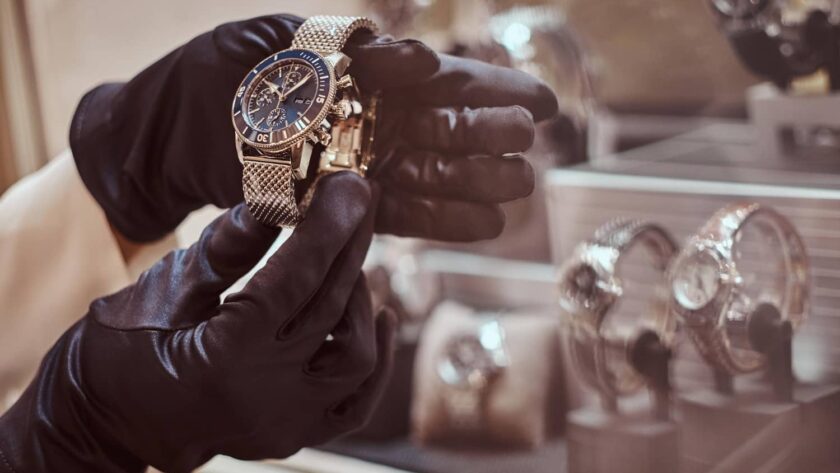
Professional Rolex appraisers verify authenticity by carefully examining the serial and model numbers, movement, case, and dial details. Diamond Banc’s dependable Rolex appraisal team uses specialized tools, including loupes and timegrapher machines, to assess craftsmanship, materials, and performance.
By cross-checking engravings and documentation against Rolex’s strict standards, their expertise ensures accurate evaluations and confirms the legitimacy of each timepiece.
What “Authenticity” Really Means
When appraisers talk about authenticity, they’re not just checking whether a watch says “Rolex” on the dial. They’re verifying that every component—the case, bracelet, dial, hands, and especially the movement inside—is made by Rolex and matches the model it’s supposed to be.
Authenticity also covers originality. Even genuine Rolex watches can lose value if parts have been replaced with aftermarket components. The goal is to determine whether the watch is 100% Rolex or a “Frankenwatch” assembled from mixed parts.
Step 1: Checking Serial and Reference Numbers
Every Rolex watch has two crucial sets of numbers:
- The serial number, which identifies the specific watch
- The reference (model) number, which indicates the model type
Older Rolex models have these numbers engraved between the lugs (behind where the bracelet connects). Modern versions display them on the rehaut, the inner rim just under the crystal.
A professional appraiser will:
- Inspect the engraving quality – Genuine Rolex engravings are razor-sharp, clean, and perfectly aligned. Counterfeits often have rough or shallow markings.
- Cross-check serial numbers – They’ll compare the serial number with Rolex production records to confirm it matches the stated production year.
- Verify consistency – The serial and model numbers must align with the correct case type, dial style, and movement for that generation.
Also Read: Top 25 Expensive Clothing Brands
Step 2: Examining the Dial and Hands
The dial (watch face) is one of the easiest ways to spot a fake if you know what to look for.
Appraisers pay attention to every detail:
- Font and spacing: Genuine Rolex dials have perfectly printed text. Even a slight misalignment or uneven spacing is suspicious.
- Crown logo: The Rolex coronet should be crisp, symmetrical, and properly placed.
- Hour markers and lume: The luminous material on the hour markers should be applied evenly. In fakes, it may look blotchy or off-center.
- Date magnification: Rolex’s famous Cyclops lens magnifies the date 2.5×. Many replicas don’t get this right; their magnification is either too low or uneven.
Under magnification, the difference between authentic craftsmanship and imitation becomes clear.
Step 3: Inspecting the Case, Bracelet, and Clasp
A Rolex isn’t just admired for its face; its construction speaks volumes about its authenticity.
- Material Quality and Weight: Real Rolex watches feel solid and balanced. The company uses high-grade metals like 904L Oystersteel, 18k gold, and platinum.
- Finish and Detailing: Appraisers check for flawless brushing and polishing, perfectly machined edges, and a smooth, consistent finish. Loose or rattling bracelets are a red flag.
- Clasp and Engravings: Even the clasp offers clues. The Rolex crown logo, model code, and clasp finish are precise.
Step 4: Opening the Case to Examine the Movement
Inside every Rolex is a movement built with meticulous precision. Appraisers look for:
- Correct caliber: Each model corresponds to a specific movement type. For example, a Datejust should contain the correct automatic movement for its era.
- Finishing quality: Genuine Rolex movements are beautifully polished, with the brand’s markings engraved (not stamped or printed).
- Performance: Appraisers use timing machines to measure accuracy. Rolex movements should meet chronometer standards—within a few seconds per day.
Step 5: Looking for Micro-Engravings and Security Features
Rolex has added subtle security elements over the years to fight counterfeiting. A professional appraiser knows precisely where to look.
- Rehaut engraving: Since the early 2000s, Rolex has engraved “ROLEX ROLEX ROLEX” around the rehaut with the serial number at 6 o’clock.
- Laser-etched crown: A nearly invisible crown is etched into the crystal at the 6 o’clock position—visible only under magnification.
- Warranty card and paperwork: Modern Rolexes include plastic warranty cards with advanced anti-counterfeiting features, including microprinting and holographic elements.
Also Read: Three Tips to Turn Your Passion for Hiking into an Apparel Brand
Step 6: Reviewing Documentation and Provenance
Even if the physical watch looks perfect, documentation completes the picture.
Appraisers verify the following:
- Original warranty card – Must list the correct serial and model numbers, an authorized dealer stamp, and the date of sale.
- Box and manuals – While not essential, original packaging adds credibility and resale value.
- Service records – These show the watch has been properly maintained and serviced with authentic Rolex parts.
Missing paperwork doesn’t always mean the watch is fake, but it can affect both confidence and value.
Step 7: Using Specialized Tools
Professional Rolex appraisers rely on a suite of precision instruments:
- 10× loupe or microscope – To inspect fine engravings and dial printing.
- Timing machine – To test movement accuracy in multiple positions.
- Digital scale – To verify the expected weight of a specific model.
- XRF metal analyzer – To confirm the purity of gold or platinum without damaging the watch.
- UV light – To examine lume quality and detect hidden markings.
These tools provide objective data to support visual inspection.
Step 8: Evaluating Overall Condition and Value
Once authenticity is confirmed, the appraiser determines the watch’s market value. This depends on factors like:
- Model rarity and production year
- Condition (scratches, polish, replaced parts)
- Original packaging and papers
- Market demand
Even small details, such as a vintage dial variant or a rare bezel color, can significantly affect price.
The Bottom Line
Professional Rolex appraisers combine expertise, technology, and deep knowledge of watchmaking history to ensure each piece they examine is authentic. From serial numbers and laser etchings to movement inspections and paperwork verification, their process leaves no stone unturned.
If you’re selling or lending a Rolex, always have it authenticated by a reputable professional. After all, when it comes to a timepiece as legendary as a Rolex, authenticity is everything!